
AI hardware in November 2026, from desk to data centre
By Andrew Miller ·
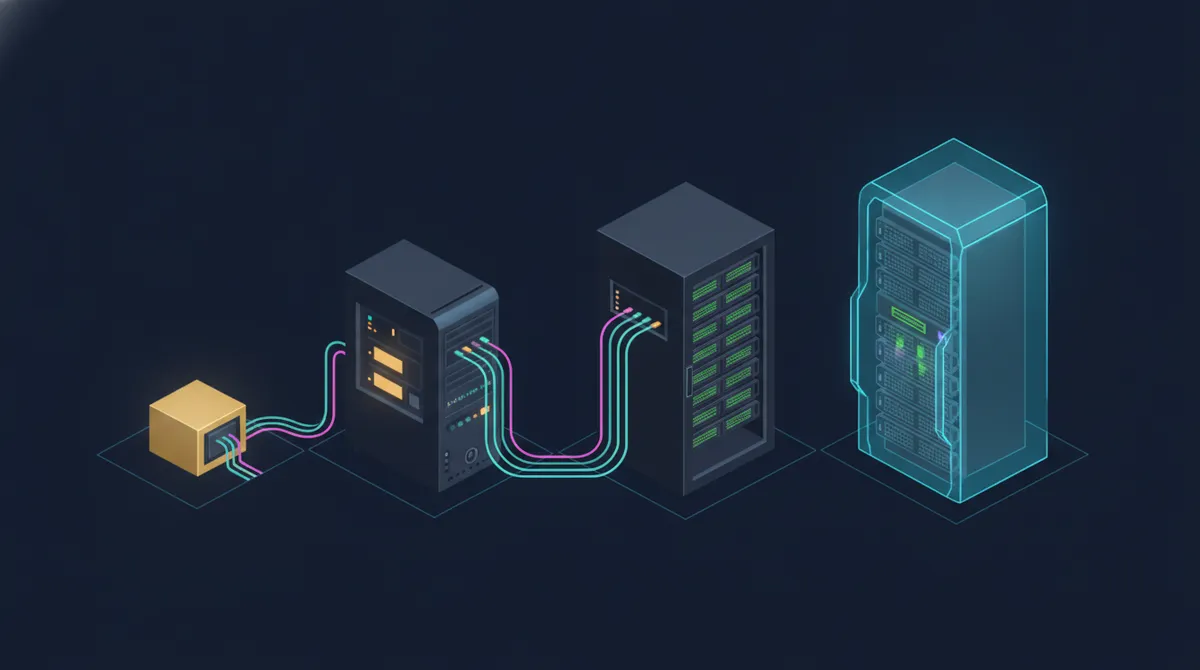
If you want to run open models on your own hardware, memory decides almost everything. It decides which models load at all, and its speed decides how fast they answer. This guide covers what NVIDIA sells or rents out in November 2026, from a box that fits on a desk to a full rack. Each machine is sized against models we have reviewed. Prices have risen sharply this year because memory chips are scarce, so check the figures here against a live quote before you buy.
DGX Spark and the GB10 boxes: 128 GB on your desk
DGX Spark is a mini-PC built on NVIDIA’s GB10 chip. Its CPU and GPU share one pool of memory, and the machine runs Linux. According to NVIDIA’s spec page, that pool is 128 GB of LPDDR5x at 273 GB/s. NVIDIA quotes up to 1 petaflop of FP4 compute, a theoretical figure that assumes sparsity, and says one unit handles models of up to 200 billion parameters. Acer, ASUS, Dell, GIGABYTE, HP, Lenovo and MSI sell their own GB10 versions. The chip is the same in all of them, so you are paying for the case, the storage and the warranty.
The price is the story. Spark launched at $3,999 in October 2025. NVIDIA raised it to $4,699 in February, blaming memory supply. In October the 128 GB model went to $6,950, nearly 75 percent more than a year earlier, per The Register. A 64 GB version from partners went on sale on 23 October at $4,999, per ServeTheHome. It keeps the 200 Gbps network port, so you can link up to four units.
A sibling chip, RTX Spark, now ships in Windows laptops. They went on sale on 16 October from $2,599, per Tom’s Hardware, but that price buys 24 GB. A 128 GB model costs about $5,100 to $7,000.
What fits in 128 GB: gpt-oss-120b (4.0) is a 65 GB download on Ollama. The 4-bit build of Nemotron 3.5 Super VL (4.1), about 75 GB, is aimed squarely at DGX Spark. Qwen3.8-27B (4.5) and Gemma 4 (4.4) fit with room to spare. The 64 GB model is tighter than it sounds: gpt-oss-120b no longer fits. Flint (3.9), which needs 48 GB, still does.
DGX Station and HP ZGX Fury: 748 GB beside the desk
DGX Station is the step up. It is a deskside tower built on the GB300 chip, which pairs a Blackwell Ultra GPU with a 72-core Grace CPU. NVIDIA lists 748 GB of memory that both chips can address, in two tiers. The GPU’s own 252 GB of HBM3e runs at 7.1 TB/s. The other 496 GB is LPDDR5X attached to the CPU, at 396 GB/s. NVIDIA quotes up to 20 petaflops of AI compute. NVIDIA designs the board but does not sell a finished Station or publish a price. ASUS, Dell, Exxact, GIGABYTE, HP, MSI and Supermicro build the machines. An Exxact model was listed at $94,930.
The HP ZGX Fury G1n is HP’s version of the DGX Station, not a separate chip. HP’s product page and QuickSpecs list the same GB300 chip and 748 GB of memory, along with up to 20 petaflops of FP4 compute and two 400 Gb network ports for linking two units. HP says one Fury can host models of up to a trillion parameters at FP4. It ships with Ubuntu 24.04. Windows was shown publicly on 7 October, but HP has announced no price or date for the Windows version.
The Linux model can be ordered through HP’s sales team, and HP publishes no list price. It is liquid-cooled, weighs from 41 kg, and has a 1,600 W power supply. HP says it needs its own 200 to 240 V circuit, so plan where it will plug in before you order one.
What fits in 748 GB: MiniMax-M3.1-Flash (4.0) at about 250 GB and Beam (3.8) at 273 GiB in NVFP4. The FP8 weights of GLM-5.3-Flash (4.3) come to about 330 GB, and the NVFP4 weights of Muse Spark Open (4.0) to about 537 GB, though its model card advises 700 GB once you count the memory that holds a long conversation. All of these fit the total, but only the first 252 GB sits in fast GPU memory. Anything that spills over runs at the slower CPU-memory speed.
Grace Blackwell Ultra in the data centre: GB300 NVL72 and B300
Most teams rent this tier rather than buy it. GB300 NVL72 is a liquid-cooled rack that links 72 Blackwell Ultra GPUs and 36 Grace CPUs into one system, with 20 TB of HBM3E. NVIDIA quotes 1,080 petaflops of FP4 compute without sparsity and lists it as available now. The more common unit is the HGX B300 server, with eight GPUs and 2.1 TB of memory in total, which NVIDIA says is shipping.
By the hour, one B300 costs $6.94 on Runpod’s community cloud and $8.99 on its secure cloud, per its price list. Verda charges $11.35 for a B300 and $13.05 for a GB300. That puts an eight-GPU server at roughly $55 to $90 an hour. For scale, $6,950 for a Spark buys about 1,000 hours on Runpod’s cheapest B300.
This is the tier the largest open models need. Kimi K3 (4.3) is a 1.56 TB checkpoint whose vLLM recipe sets a floor of eight GB300 GPUs. Hy4 preview (4.2) runs on eight B300s in FP8. GLM-5.3 (4.4), at about 753 GB, and DeepSeek-V4-Pro (4.3), at about 865 GB, also need a full eight-GPU server.
Vera Rubin: shipping, but you cannot buy it in small amounts
Vera Rubin is the generation after Blackwell. It pairs NVIDIA’s new Rubin GPU with its own Vera CPU. Its main rack is the Vera Rubin NVL72, which NVIDIA previously called NVL144 because it counted the two GPU dies in each package separately, ServeTheHome explains. NVIDIA’s page lists 72 Rubin GPUs, each with 288 GB of HBM4, for 20.7 TB per rack. It quotes 3,600 petaflops of FP4 for running models and 2,520 for training.
The status, in order. In May NVIDIA said Vera Rubin was ramping into full production, with shipments from the autumn. Its August results said racks were running at CoreWeave, Google Cloud, Microsoft Azure, Oracle and Nebius. Tom’s Hardware reported NVIDIA expects Rubin to be about 20% of data-centre revenue this quarter. CoreWeave opened limited availability on 30 September, and Oracle announced general availability on 27 October. None of the price lists we checked shows a public hourly rate.
Rubin CPX, a cheaper chip NVIDIA announced for reading long prompts, does not appear in either of those NVIDIA releases. Neither does Rubin Ultra. Treat any date you see for them as rumour until NVIDIA confirms it.
The comparison
| System | Memory | FP4 (vendor figure) | Price | Status |
|---|---|---|---|---|
| DGX Spark / GB10 boxes | 64 or 128 GB unified, 273 GB/s | Up to 1 PF, with sparsity | $4,999 (64 GB); $6,950 (128 GB) | Shipping |
| DGX Station / HP ZGX Fury | 748 GB (252 GB HBM3e + 496 GB LPDDR5X) | Up to 20 PF | No list price; Exxact listed $94,930 | Orderable via partners |
| HGX B300 (8 GPUs) | 2.1 TB HBM3e | 108 PF dense | $6.94 to $11.35 per GPU-hour rented | Shipping |
| GB300 NVL72 rack | 20 TB HBM3E | 1,080 PF dense | Contact sales; GB300 $13.05 per GPU-hour on Verda | Available |
| Vera Rubin NVL72 rack | 20.7 TB HBM4 (288 GB per GPU) | 3,600 PF for running models | Not published | Early cloud availability |
Outside NVIDIA
Two alternatives are worth knowing about. AMD’s Ryzen AI Halo pairs the Ryzen AI Max+ 395 with 128 GB of unified memory for $3,999, at up to 256 GB/s. That memory is about the same size and speed as Spark’s, for less money, though NVIDIA’s CUDA software does not run on it.
Apple’s Mac Studio with M5 Ultra goes up to 512 GB at 1.2 TB/s, more than four times Spark’s memory speed. The 512 GB configuration costs at least $22,299. That is enough for the 214 GB 4-bit build of Qwen3.5-397B (3.6), with room to spare.
The catch: the FP4 figures in the table are NVIDIA’s own peak numbers, sometimes with sparsity and sometimes without, so they are no guide to how fast a model will actually answer. For running models on a desk, memory speed usually matters more, and Spark’s 273 GB/s is the slowest on this list. Software is the other limit. A 4-bit NVFP4 build of a model needs a Blackwell-generation GPU. vLLM (4.7) and SGLang (4.4) are the servers the big-model guides assume. llama.cpp (4.8) and Ollama (4.6) are the easy path on Spark, Halo and Mac, and MLX (4.4) is the native choice on a Mac.
Our take: work out how much memory your model needs before you look at compute figures. Under about 100 GB, a 128 GB Spark or Halo will run it, if not quickly. Between roughly 200 and 500 GB, a Mac Studio or a DGX Station holds it on one desk, at the price of a car or a small house. Anything bigger is a rental, and at under $10 a GPU-hour, a few hundred hours of B300 time will tell you more than a $95,000 tower.