
Cline vs Roo Code vs Aider vs OpenCode: Open-Source Coding Agents Compared
By ReviewRamble editors ·
Quick verdict
Of these four open-source coding agents, only two are still moving. OpenCode is the terminal agent to pick if you want any model and the largest community, provided you keep its local server patched. Cline is the pick for VS Code, with every edit and command shown for approval before it runs. Aider still has the cleanest git discipline of any agent, but its last commit was on 22 May 2026. Roo Code's repository is archived, and its makers have moved on to a self-hosted cloud agent called Roomote; former Roo users mostly land on Kilo Code. For a new setup in November 2026, the real choice is OpenCode or Cline, depending on whether you live in a terminal or an editor.
Comparison at a glance
| Cline | Roo Code | Aider | OpenCode | |
|---|---|---|---|---|
| Status | Active (v4.1.27, 21 November 2026) | Archived; last release v3.54.0, 15 May 2026 | Stalled; last commit 22 May 2026 | Active, several releases a week |
| Where it runs | VS Code and CLI; JetBrains on Enterprise | VS Code | Terminal | Terminal, desktop app, web, SDK |
| Licence | Apache 2.0 | Apache 2.0 | Apache 2.0 | MIT |
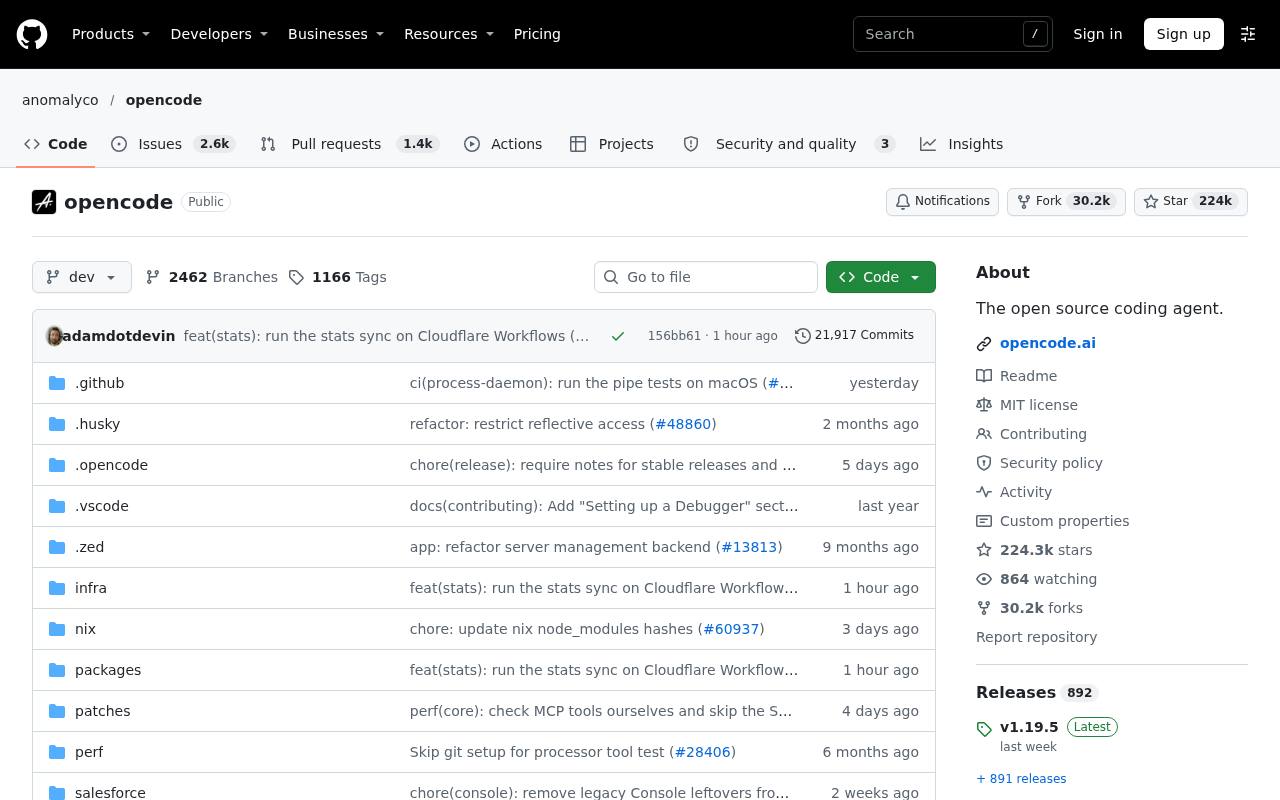
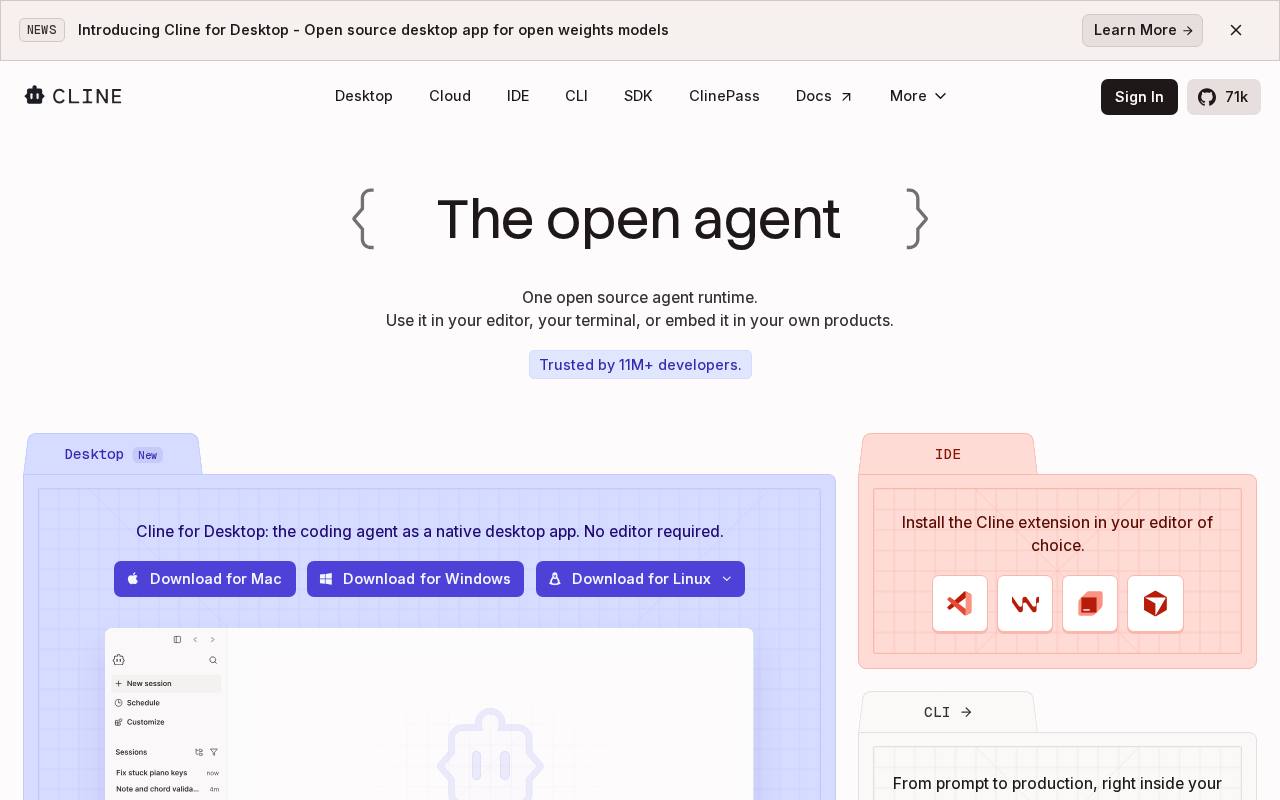
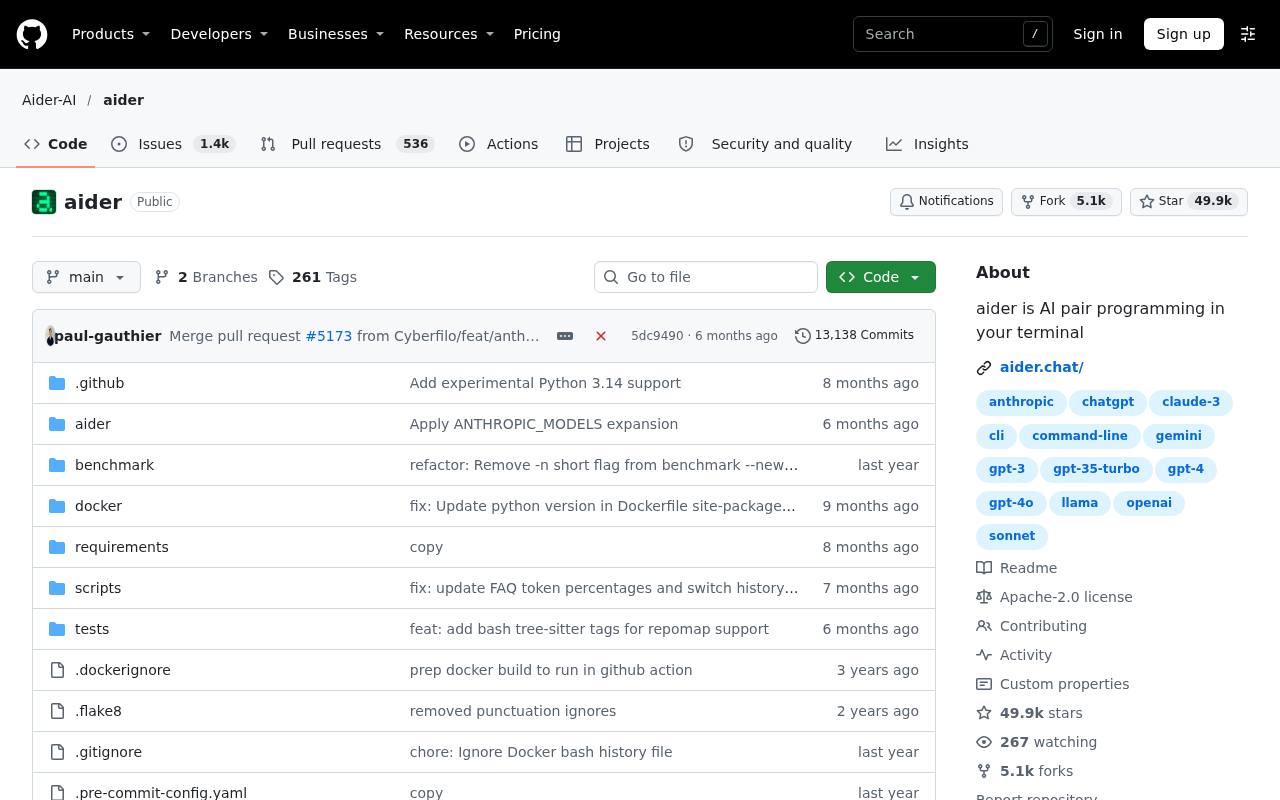
| GitHub stars | About 71,900 | About 24,200 | About 50,300 | About 229,000 |
| Models | Almost any provider, or Cline at cost | Any provider (no longer updated) | Almost any, including local through Ollama | 75+ providers, local models, your own gateway |
| Approval model | Every edit and command approved | Modes: Code, Architect, Ask, Debug, custom | Every change is a git commit | Build and read-only Plan agents, configurable permissions |
| MCP | Yes, with a marketplace | Yes | No | Yes |
| Optional paid plan | ClinePass $9.99 a month; Enterprise custom | None | None | Go $10, Go Plus $40; Zen pay as you go; Enterprise per seat |
Pricing, checked on 25 November 2026
- Cline: the VS Code extension and CLI are free; you pay your model provider, or buy inference from Cline at cost. ClinePass is $9.99 a month after a promotional period for 14 open-weight models from six labs, with quotas described only as two to five times standard API rate limits. Enterprise (SSO, JetBrains extension, role-based access, audit logs) is custom-priced.
- Roo Code: free, but no longer developed. roocode.com now redirects to Roomote, which is free to self-host with your own keys and lists no paid plans.
- Aider: free; you pay your model provider or run local models.
- OpenCode: free; you pay your model provider. OpenCode Go is $10 a month and Go Plus $40, with per-model allowances over five-hour, weekly and monthly windows. Zen sells models per token. Enterprise is per seat, price on request.
Why "open source" is not the whole decision
All four let you read the code, bring your own model key and keep prompts away from a middleman. That is why teams with an existing Anthropic, Bedrock or Vertex contract like them: no new SaaS processor for source code, and no seat fee. The bill is tokens, and with frontier models a busy developer can pass the price of a $20 subscription agent within days. If a flat monthly cost matters, compare against Claude Code or Codex on their own plans (see Claude Code vs Codex).
The bigger question in 2026 is maintenance. An agent that runs shell commands on your machine is security-sensitive software, and one that no longer ships fixes or support for new models is a liability that grows each month. That is why two of the four come with a warning.
Cline: the open-source agent for VS Code
Cline shows every file edit and command before it runs, works with almost any provider, and with your own key sends code straight from your machine to that provider. It ships often, and since Roo Code stopped it has become the default open-source agent inside VS Code.
Check the defaults before a rollout. Cline's docs say usage telemetry, without code, is on by default in every product. In February 2026 a leaked npm token let an attacker publish a tampered cline@2.3.0 to npm for about eight hours; the marketplace extension was not affected, and npm publishing moved to OIDC provenance afterwards. JetBrains support, SSO and role-based access are Enterprise-only.
Strengths: approval for every action, any model, an auditable Apache 2.0 codebase, VPC and on-prem options on Enterprise. Weaknesses: token bills you see after the fact, telemetry on by default, no tab autocomplete of its own.
Roo Code: archived, with a successor elsewhere
Roo Code began as a fork of Cline and was popular for its modes: separate Code, Architect, Ask and Debug personas, plus custom ones, each with its own instructions and permissions. Its final release, v3.54.0, came on 15 May 2026, and the GitHub repository is now archived, so there are no more security fixes or new model support.
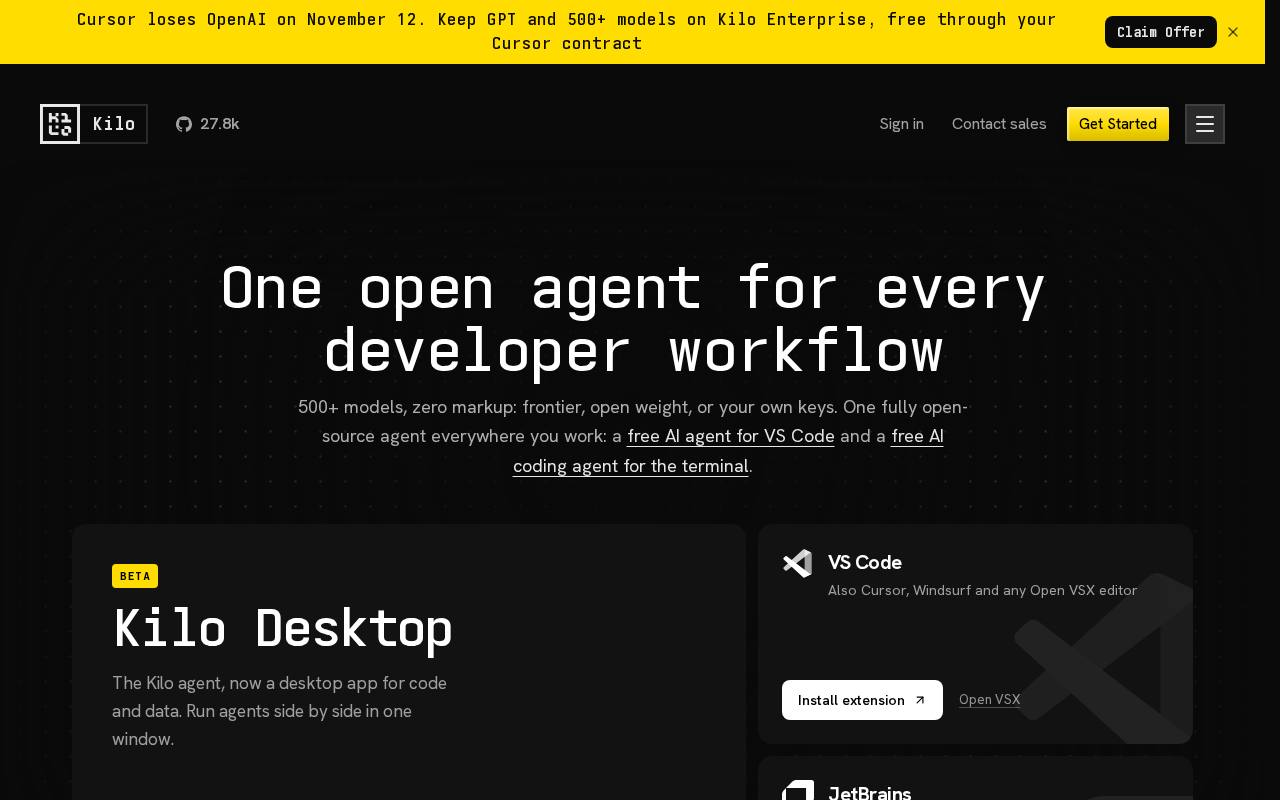
The team's new project, Roomote, is a different kind of tool: an open-source, self-hosted cloud agent that answers repository questions and opens pull requests, and it currently uses OpenCode as its harness. If you want Roo's mode-based workflow inside the editor, Kilo Code is the closest maintained option. We would not install Roo Code on a new machine.
Strengths: a well-liked modes system that still works for existing users. Weaknesses: archived, no updates, no path forward inside the extension itself.
Aider: a good habit, not a new start
Aider turns every change into a git commit you can review or undo, keeps the model's view of the codebase small with a tree-sitter repo map, lints each edit and can run your tests and fix failures. Its polyglot leaderboard is still quoted in model comparisons.
Development has all but stopped. The last tagged GitHub release is v0.86.0 from August 2025, PyPI has 0.86.2 from 12 February 2026, and the last commit landed on 22 May 2026. There is no MCP support and no sub-agents, and it does not install on Python 3.13. It still works with the models it knows about, but new models depend on someone adding them.
Strengths: commit-per-edit discipline, small context through the repo map, opt-in analytics that exclude code. Weaknesses: no active development, no MCP, Python 3.13 unsupported.
OpenCode: the terminal agent with the momentum
OpenCode has about 229,000 GitHub stars, more than Cline, Aider and Roo Code combined, and ships several releases a week. It works with more than 75 providers, including local models and your own gateway, has a read-only Plan agent for exploring unfamiliar code, and keeps the same agents and MCP setup when you switch from Claude to GPT to an open-weight model. Go at $10 a month is a cheap way to reach a set of low-cost models without managing keys.
Its design carries a known risk: a local HTTP server that the terminal, desktop app and SDK talk to. That server has needed three security fixes in 2026, and opencode web serves without a password unless you set one. Pin a current version, and treat opencode serve as a privileged service.
Strengths: any model, the largest community, MIT licence, cheap optional model plans. Weaknesses: local server security history, output quality depends entirely on the model you choose, a fast-moving codebase.
A fair way to test the two live options
Give OpenCode and Cline the same model and the same three tasks: a bug fix with a failing test, a small feature across three files, and a refactor that renames a widely used function. Record tokens used, how many approvals or corrections you made, and whether the final diff passes review without edits. Because both are model-agnostic, the result tells you about the agent's workflow rather than the model behind it, which is the comparison you actually need.
Which one for which job
| If you need | Pick | Why |
|---|---|---|
| An agent inside VS Code that asks before every action | Cline | The maintained open-source standard for the editor |
| A terminal agent that works with any model | OpenCode | 75+ providers, active development, cheap optional plans |
| Roo Code's modes, still maintained | Kilo Code | The nearest heir to Roo's workflow |
| Commit-per-edit discipline on an existing setup | Aider | Still works, but do not build a new workflow on it |
| Enterprise rollout with SSO | Cline Enterprise or OpenCode Enterprise | Both offer central config; neither publishes a price |
For two-way detail, read OpenCode vs Cline, OpenCode vs Codex and Cline vs Kiro. For the commercial agents, see Claude Code vs Codex vs Cursor vs Copilot, and for the whole field, AI code editors and coding agents compared.
FAQ
Is Roo Code discontinued?
Its GitHub repository is archived and the last release was v3.54.0 on 15 May 2026. The website now redirects to Roomote, a self-hosted cloud agent from the same team. Existing installs keep working, but they receive no fixes.
Is Aider still maintained?
Not actively. The last commit was on 22 May 2026 and the last PyPI release, 0.86.2, on 12 February 2026. It still works with supported models and Python 3.10 to 3.12.
Are these agents really free?
The software is. You pay your model provider for tokens, which can exceed a $20 subscription with frontier models. Cline's ClinePass at $9.99 and OpenCode Go at $10 cap spend on open-weight models.
Which is safest to run on a work machine?
Cline, because every edit and command waits for approval, though its telemetry should be switched off if policy requires. OpenCode is fine when kept on a current version with its server password set. Avoid Roo Code, which gets no security fixes.
Can I use local models?
Yes with all of them. OpenCode and Cline support local providers directly, and Aider documents Ollama. Expect weaker results on large changes than with frontier models.
Sources and verification
Prices, release dates and repository figures come from the projects' own pages and GitHub, read on 25 November 2026. These are source links, not evidence that ReviewRamble ran controlled benchmarks.
- Cline: Pricing, ClinePass, GitHub repository.
- Roo Code: GitHub repository (archived); Roomote: Homepage.
- Aider: GitHub repository, PyPI.
- OpenCode: GitHub repository, OpenCode Go.
Editorial disclosure: this article contains no proprietary benchmark measurements and no affiliate-sponsored rankings.