
OpenRouter vs LiteLLM vs Portkey vs Vercel AI Gateway: Which LLM Gateway Should You Use?
By ReviewRamble editors ·
Quick verdict
OpenRouter is the quickest way to reach hundreds of models with one key and one bill, at a 5.5% fee on credits. LiteLLM is the gateway to run yourself when several teams share provider keys and need budgets, provided you pin and verify every release. Vercel AI Gateway is the hosted option with no token markup, and it works from any cloud, not only Vercel. Portkey's open-source gateway is still a light, capable router, but it has had no release since January 2026 and its hosted product now sells through Palo Alto Networks.
Comparison at a glance
| OpenRouter | LiteLLM | Portkey Gateway | Vercel AI Gateway | |
|---|---|---|---|---|
| Type | Hosted marketplace and router | Self-hosted Python proxy and SDK | Self-hosted TypeScript router; hosted version via Palo Alto | Hosted gateway |
| Licence | Closed | MIT, except enterprise/ folder | MIT | Closed |
| Who pays the provider | OpenRouter, from your credits; or you, with your own keys | You, with your own keys | You, with your own keys | Vercel, from your credits; or you, with your own keys |
| Fee | 5.5% on credits (Standard), 8% (Business); own keys free to $25,000 a month, then 5% | None for open source; Enterprise by quote | None for open source; hosted prices no longer public | No token markup; paid add-ons such as regional endpoints at 5% |
| Budgets and spend limits | Yes, on paid plans | Virtual keys and budgets in the free build | Hosted and enterprise plans only | Per team, project, key or member |
| Main caution | Fee grows with spend; no published latency overhead | Holds every key you own; long security advisory list | Quiet release calendar since the acquisition | Budgets do not cover spend on your own keys |
What a gateway is for, and when you do not need one
A gateway sits between your code and the model providers. Your app calls one address in one format, and the gateway picks the provider, retries on failure, falls back to another model, records the cost and stops a team when it hits its budget. That is worth having when you use several providers, when finance wants spend per team, or when one provider's outage should not take your product down.
If you call one or two providers from one service, you may not need one at all. The providers' own SDKs with a retry wrapper are simpler and remove a network hop. Our LLM routing guide makes that case in full.
The four here split into two pairs. OpenRouter and Vercel are services you rent: nothing to run, and the bill is a balance of credits. LiteLLM and Portkey are software you run: no fee, but you own the servers, the upgrades and the fact that one process now holds every provider key your company has.
Pricing, as of 26 November 2026
OpenRouter bills inference at provider list price and charges its fee when you buy credits: 5.5% on Standard and 8% on Business, with discounts available on Enterprise. Bringing your own provider keys carries no fee on the first $25,000 of list-price usage a month and 5% above that. The free tier offers 25 or more free models at 50 requests a day. Business adds EU and US in-region routing, up to 1,000 workspaces and a signed data processing agreement on request; Enterprise adds SSO, contractual SLAs and invoicing. On $40,000 of monthly spend, the Standard fee is about $2,200.
LiteLLM is free to run. Enterprise, which adds SSO and SCIM, audit logs, multi-region control and 24/7 support with response-time targets, is custom-priced, and a 30-day trial key is available. Your cost is the infrastructure (the proxy and its Postgres database) and the engineer who keeps it upgraded.
Portkey's gateway is free under MIT. Its hosted plans used to publish prices, but on 26 November 2026 portkey.ai/pricing redirected to a Palo Alto Networks AI gateway contact page, so the hosted product is now priced by sales.
Vercel AI Gateway charges no markup or platform fee on tokens, including when you bring your own key. You buy AI Gateway Credits and pay the provider's list price per request; payment processing fees are yours, and Enterprise teams can pay by invoice. Every Vercel team gets a monthly free credit on a subset of models, with lower rate limits, which ends once you buy credits. The extras cost money: a team-wide provider allowlist or team-wide zero data retention is $0.10 per 1,000 requests, regional EU or US endpoints add 5% of inference cost, turning off fallback to Vercel's keys on your own keys costs $0.20 per 1,000 requests, and trace drains to your own observability tool cost $0.05 per 1,000 traces plus $0.50 per GB.
OpenRouter
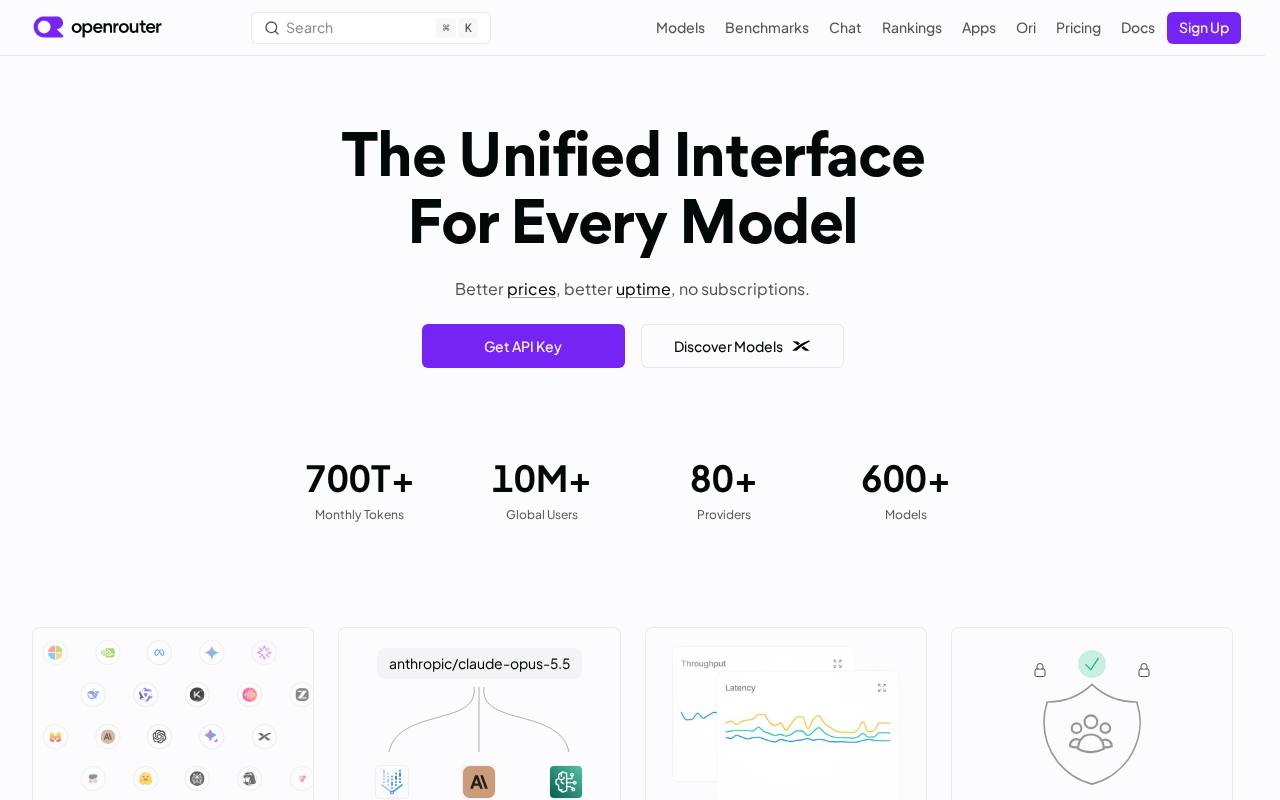
OpenRouter turns many accounts into one key and one balance behind an OpenAI-compatible endpoint, with over 600 models from more than 80 providers on its pricing page. When one provider for a model is slow or down, it routes to another. It is most useful early, before you know which model you will settle on, and for apps that genuinely mix models from several labs.
Strengths: the widest catalogue; nothing to run; zero data retention can be enforced per request; in-region routing on Business.
Weaknesses: the fee scales with spend, so a team that settles on one model at high volume pays for flexibility it no longer uses; no published figure for added latency; enforcing zero data retention can narrow which providers are eligible, and with them your fallbacks.
LiteLLM
LiteLLM puts more than 100 providers behind one OpenAI-format API, ships a release every few days (v1.109.5 came out on 25 November 2026) and has about 63,900 GitHub stars. Virtual keys, per-team budgets, rate limits and fallbacks all work in the free build, and many tools ship a LiteLLM integration, so it rarely becomes the odd part of a stack.
Strengths: breadth; budgets and keys without a licence; your data never leaves your network; a large ecosystem.
Weaknesses: the security record. In March 2026 attackers with a stolen PyPI token published two poisoned releases that harvested credentials for about 40 minutes, and the project published 17 advisories in 2026, four rated critical. Run the -stable Docker images, verify signatures and never expose the admin interface. Our LiteLLM vs Portkey Gateway and LiteLLM vs Bifrost comparisons go further, the second against a faster Go gateway, Bifrost.
Portkey Gateway
Portkey's design is the reason people chose it: one JSON config describes fallbacks, retries, conditional routing and output guardrails, and the small TypeScript core runs on Node, Bun, Docker or Cloudflare Workers, where a Python proxy cannot. It has about 13,400 GitHub stars and an MIT licence.
Strengths: the lightest footprint here; edge runtimes; a clean config model.
Weaknesses: the latest release is still v1.15.2 from 12 January 2026, months before Palo Alto Networks completed its acquisition. The README promotes a Gateway 2.0 pre-release branch that folds the enterprise gateway into open source, but nothing has shipped from it. Logs, budgets and analytics live in the hosted product, which now sits inside Palo Alto's security line. Fine to run today; hard to build a roadmap on.
Vercel AI Gateway
Vercel's gateway is a hosted API at ai-gateway.vercel.sh. You need a Vercel account to create a key, but not a Vercel project, so a Python service on another cloud can use it. It speaks OpenAI Chat Completions, OpenAI Responses and Anthropic Messages, plus Vercel's own AI SDK, and covers text, images, video, speech, embeddings and reranking. Each request log records the provider attempts, latency, tokens and cost.
Strengths: no token markup, which beats OpenRouter's fee at any volume; budgets per team, project, key or member; prompt caching across providers; nothing to run.
Weaknesses: the add-ons are where the bill grows, and regional endpoints at 5% of inference cost erase much of the saving over OpenRouter for teams that need EU data handling. Budgets do not count spend on your own keys, and by default a failed request on your key retries on Vercel's keys and bills your credits. It is closed and hosted only. We have not reviewed it separately yet.
Winner by use case
- A prototype that tries many models from many labs: OpenRouter. The widest catalogue and nothing to set up.
- Hosted routing at steady volume, with no fee on tokens: Vercel AI Gateway, after you price the add-ons you need.
- Several internal teams sharing provider contracts, with budgets you control: LiteLLM, self-hosted, pinned and verified.
- A router on Cloudflare Workers or another edge runtime: Portkey's gateway, accepting a quiet release calendar.
- EU data residency: OpenRouter Business or Vercel's regional endpoints if hosted; LiteLLM in your own EU region if not.
- One provider, one service: none of them. Call the provider directly.
FAQ
Is Vercel AI Gateway only for apps hosted on Vercel?
No. Vercel's docs say your application does not need to run on Vercel; any server can call it with an AI Gateway API key. Deployments on Vercel can authenticate with OIDC instead of a key.
Does OpenRouter mark up model prices?
Not per token. It charges list price and takes 5.5% (Standard) or 8% (Business) when you buy credits. With your own provider keys, the first $25,000 a month is free of fees and 5% applies above that.
Is Portkey's gateway abandoned?
Not formally. The repository is open, MIT-licensed and carries no archive notice, but its last release was v1.15.2 in January 2026 and the 2.0 branch has not shipped. Treat it as stable software with an uncertain future.
Is self-hosting LiteLLM cheaper than OpenRouter?
At high spend, usually: 5.5% of $40,000 a month is about $2,200, more than a small proxy cluster costs to run. Below a few thousand dollars a month, the engineer's time to run, upgrade and secure LiteLLM costs more than the fee.
Can I combine them?
Yes, and many teams do: LiteLLM in front for internal keys and budgets, with OpenRouter or Vercel configured as one of its providers for models you do not contract directly. Each extra hop adds latency, so keep the chain short.
Sources and verification
Prices were read from each vendor's own pages on 26 November 2026. These are source links, not evidence that ReviewRamble ran controlled benchmarks.
- OpenRouter: Pricing
- LiteLLM: Enterprise and GitHub
- Portkey: Gateway on GitHub and releases
- Vercel: AI Gateway docs and AI Gateway pricing
Editorial disclosure: this article contains no proprietary benchmark measurements and no affiliate-sponsored rankings.