
Supabase vs Firebase vs Convex vs Appwrite: The Best Backend for AI Apps
By ReviewRamble editors ·
Quick verdict
For most AI apps, Supabase is the safest default: it is Postgres underneath, so your embeddings sit in the same database as your users and orders, and the bill is easy to predict. Convex is the pick for chat-style apps where every screen updates live and you would rather write TypeScript than SQL. Firebase makes sense if you are already inside Google Cloud and want Gemini a function call away. Appwrite is the all-in-one choice for teams that want one subscription covering backend and hosting, or the option to run it all on their own servers. None of them wins every case.
Comparison at a glance
| Supabase | Firebase | Convex | Appwrite | |
|---|---|---|---|---|
| Database | Postgres | Firestore (document store), plus Postgres through SQL Connect | Its own reactive document database | TablesDB by default; DocumentsDB, VectorsDB, PostgreSQL and MySQL options |
| Vector search | pgvector inside Postgres | Firestore KNN search, up to 2,048 dimensions, flat index only | Built in on every plan | VectorsDB database type |
| Auth | Built in; 50,000 MAU free, 100,000 on Pro | Built in; 50,000 MAU free | Built in or third-party | Built in; 75,000 MAU free, 200,000 on Pro |
| Realtime | Realtime channels; 200 concurrent connections free, 500 on Pro | Firestore live listeners (not for vector queries) | Every query is live by default | Realtime subscriptions |
| Server functions | Edge Functions (Deno): 150s free, 400s paid, 2s CPU, 256MB | Cloud Functions (Blaze plan only) | Queries, mutations and actions in TypeScript | Functions in many runtimes |
| Calling AI models | Your own code in Edge Functions | Firebase AI Logic for Gemini (Blaze only) | Actions call any model API | Your own code in Functions |
| Free tier | 2 projects, 500MB database, paused after 1 week idle | Spark plan with daily quotas; functions need Blaze | 1M function calls, 0.5GB database | 2 projects, 5GB bandwidth, paused after 1 week without console activity |
| Entry paid plan | Pro from $25/month | Blaze, pay as you go | Professional $25 per developer/month | Pro from $25/month (Start from $10 in some regions) |
| Self-hosting | Yes, open source | No | Yes, fair-source licence | Yes, open source |
What an AI app asks of a backend
A typical AI app does five things the ordinary to-do app does not. It stores embeddings, the lists of numbers that let you search documents by meaning. It streams a long model reply to the screen as it is written. It calls a paid model API from a server, where the key cannot leak. It keeps a conversation history per user. And it needs to stop one enthusiastic user from running up your model bill. Every backend here handles the basics of sign-in and storage; the differences show up in those five jobs, and in what the bill looks like once real users arrive.
Supabase: Postgres with the parts bolted on
Supabase gives you a Postgres database with authentication, file storage, realtime channels and Edge Functions around it. For AI work, the important part is pgvector, the Postgres extension that adds vector columns and indexes. Your embeddings live in the same table as the rows they describe, so a single SQL query can say "the ten most similar support articles this customer is allowed to see", with your row-level security rules applied. No second database to sync.
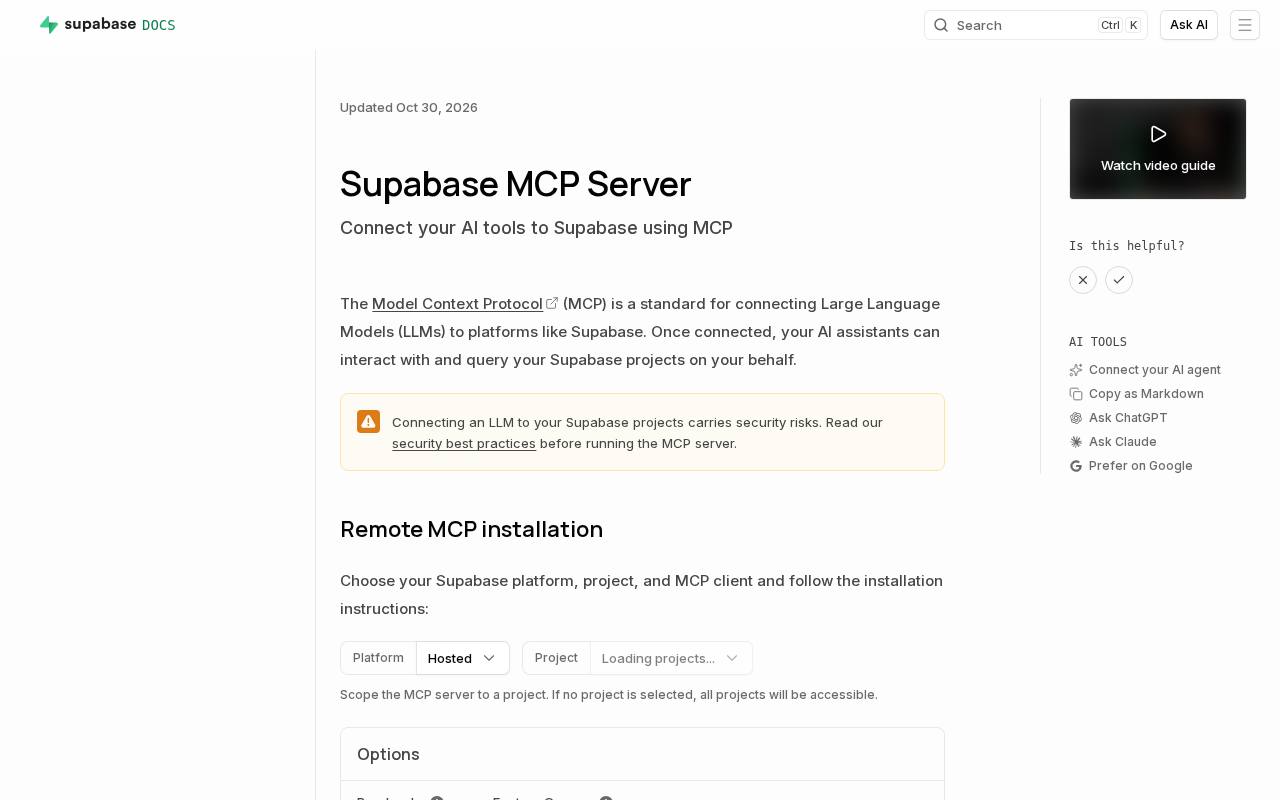
Strengths: standard Postgres, so every ORM, SQL tool and migration habit carries over; vectors and permissions in one place; predictable published overage prices; open source, so you can leave. Supabase also runs an official MCP server that lets a coding agent change schema and deploy functions; our review covers the settings to switch on first, and Redis vs Supabase compares it with Redis's.
Weaknesses: Edge Functions are short-lived: 2 seconds of CPU time, 256MB of memory, and a 150-second idle timeout before the request returns a 504. Waiting on a model API does not count as CPU, so streaming a reply is fine, but a long agent loop or heavy document processing belongs elsewhere. Free projects pause after a week of inactivity.
Pricing (supabase.com/pricing, 26 November 2026): Free gives 2 active projects, a 500MB database, 50,000 monthly active users, 500,000 function invocations and 2 million realtime messages. Pro starts at $25 a month with an 8GB database ($0.125 per extra GB), 100,000 MAU ($0.00325 each after), 2 million function invocations ($2 per extra million), 5 million realtime messages ($2.50 per extra million) and 250GB of egress ($0.09 per extra GB). Each project also pays for compute, from $10 a month, with $10 of credit included. Team is from $599 a month for organisation features, with the same usage allowances.
Firebase: Google's toolbox, Gemini included
Firebase is Google's app platform: Firestore for data, Authentication, Cloud Functions, Hosting and Storage. Its AI pitch is Firebase AI Logic, which lets your app call Gemini models from the client without you running a server for the API key. Firestore can now store vectors and run nearest-neighbour searches, though it does not create the embeddings for you and needs a vector index first.
Strengths: the most mature mobile SDKs here; Firestore's live listeners make chat screens easy; Gemini through AI Logic without writing a proxy; Google Cloud's full catalogue next door when you outgrow Firebase.
Weaknesses: vector search is limited to 2,048 dimensions with a flat index, returns at most 1,000 documents per query on the Standard edition, and does not work with realtime listeners. Firestore bills per read, write and delete, so a chatty app that rereads documents can cost far more than its traffic suggests. Cloud Functions, AI Logic and phone sign-in all require the pay-as-you-go Blaze plan. You cannot self-host it.
Pricing (firebase.google.com/pricing, 26 November 2026): Spark is free with daily Firestore quotas of 50,000 reads, 20,000 writes and 20,000 deletes, 1GiB stored and 50,000 auth MAU. Blaze keeps those free amounts and bills beyond them at Google Cloud rates; Cloud Functions include 2 million invocations a month, then $0.40 per million. AI Logic is billed at Gemini API or Google Cloud prices with no free quota listed.
Convex: a database where everything is live
Convex is a backend you write entirely in TypeScript. Queries are functions, and every query is reactive: when the data changes, every screen showing it updates without you writing subscription code. For a chat interface, a collaborative document or an agent dashboard, that removes a whole category of bugs. Vector search is built in, and actions (Convex's functions for calling the outside world) can call any model API and write results back as they arrive.
Strengths: the least code for live, multi-user interfaces; end-to-end type safety from database to front end; vector and text search included on every plan; the backend can be self-hosted under a fair-source licence that converts to Apache 2.0 after two years.
Weaknesses: it is not SQL, so analysts and existing tools cannot query it directly, and moving away later means a rewrite. The paid plan is priced per developer, which adds up for larger teams. The free database allowance is small at 0.5GB, and vector storage counts against a separate search allowance (0.5GB free, 1GB on Professional).
Pricing (convex.dev/pricing, 26 November 2026): Free and Starter include 1 million function calls ($2.20 per extra million), 20 GB-hours of action compute, 0.5GB of database storage and 1GB of bandwidth, for 1 to 6 developers. Professional is $25 per developer a month with 25 million function calls ($2 per extra million), 250 GB-hours of action compute ($0.30 per extra), 50GB of database storage and 50GB of bandwidth. Business starts at a $2,500 monthly minimum.
Appwrite: one subscription for the whole stack
Appwrite bundles authentication, databases, storage, functions, messaging, realtime and site hosting into one project, available as a cloud service or as open-source software you run yourself. Its database layer now offers several types, including a VectorsDB option for embeddings, with a choice of serverless billing or dedicated compute from $10 a month per database.
Strengths: the most generous free authentication allowance here (75,000 MAU); hosting for your front end in the same project; functions in many languages, not just JavaScript; a budget cap that stops overage charges; a full self-hosted path.
Weaknesses: the free plan freezes a project when it hits a limit, and pauses it after a week without activity in the console, which Appwrite says does not count visits from your users. Its AI-specific features are younger than Supabase's pgvector or Firebase's Gemini integration. The full plan comparison is not shown on the pricing page without JavaScript, which makes quick checks harder.
Pricing (appwrite.io, 26 November 2026): Free gives 2 projects with 5GB bandwidth, 2GB storage, 750,000 function executions and 75,000 MAU each. Start, sold only in some regions, is from $10 a month. Pro is from $25 a month with 2TB of bandwidth, 150GB of storage, 3.5 million executions and 200,000 MAU per project; extra projects are $15 each, extra bandwidth $15 per 100GB and extra executions $2 per million. Database compute includes $10 of credit a month.
Pricing at scale: one worked example
Take an AI support assistant with 20,000 monthly active users, a few gigabytes of documents and embeddings, and 3 million server function calls a month. On Supabase Pro that is the $25 plan, whose $10 compute credit covers one small project, plus $2 for the million function calls above the 2 million included: roughly $27 before egress. On Convex Professional with two developers it is $50, with 3 million calls well inside the 25 million included. On Appwrite Pro it fits the $25 base. On Firebase the answer depends almost entirely on how many Firestore reads each conversation triggers, which is why Firebase bills surprise people more than the others. In every case the model API, not the backend, will usually be the largest line on the invoice.
Which one for which job
| Your situation | Our pick | Why |
|---|---|---|
| Retrieval over your own documents (RAG) with per-user permissions | Supabase | pgvector and row-level security in one SQL query |
| Live chat or collaborative AI interface | Convex | Every query updates screens automatically |
| Mobile app already on Google Cloud, using Gemini | Firebase | AI Logic and mature mobile SDKs |
| Backend and front-end hosting under one bill | Appwrite | Sites, functions and data in one project |
| Must run on your own servers | Supabase or Appwrite | Both fully open source; Convex is fair-source |
| Analysts need SQL access to app data | Supabase | It is standard Postgres |
| Largest free auth allowance | Appwrite | 75,000 MAU on the free plan |
Our take: if you cannot decide, start with Supabase, because Postgres is the easiest thing to leave and the easiest to hire for. Convex earns the switch when your app is mostly live screens and your team writes TypeScript all day. Firebase is a sensible choice mainly when Google is already your cloud, and Appwrite when one subscription for everything matters more than the most mature AI tooling.
Frequently asked questions
Which backend is best for vector search?
Supabase, for most apps, because pgvector keeps embeddings next to your data and your permission rules. Convex's built-in vector search is simpler to set up. Firestore's works but is limited to 2,048 dimensions, a flat index and 1,000 results per query on its Standard edition.
Is Supabase cheaper than Firebase?
Usually easier to predict rather than always cheaper. Supabase charges a $25 Pro base with published allowances; Firebase charges per document read and write, which can be very cheap for light apps and expensive for apps that reread data often.
Can I stream AI responses from these backends?
Yes, with different methods. Supabase Edge Functions can return a streamed response, and time spent waiting on the model does not count against their 2-second CPU limit; Appwrite Functions can call a model the same way, so check its function docs for streaming before you build a chat screen on it. Convex actions typically write chunks to the database and every subscribed screen updates. Firebase can stream through Cloud Functions or AI Logic.
Can I self-host Supabase, Convex or Appwrite?
Supabase and Appwrite are open source and self-hostable. Convex's backend can be self-hosted under the FSL Apache 2.0 licence, which forbids building a competing hosted service and converts to Apache 2.0 after two years. Firebase cannot be self-hosted.
Do free projects get paused?
Supabase pauses free projects after one week of inactivity. Appwrite pauses free projects after one week without console activity, and freezes them if they exceed a limit. Firebase's Spark plan and Convex's free tier do not advertise inactivity pausing.
Sources and verification
Prices were checked on the vendors' own pages on 26 November 2026. These are source links, not evidence that ReviewRamble ran benchmarks.
- Supabase: Pricing and Edge Function limits
- Firebase: Pricing and Firestore vector search
- Convex: Pricing and Self-hosting
- Appwrite: Pricing, Pricing update and Start plan
Editorial disclosure: this article contains no proprietary benchmark measurements and no affiliate-sponsored rankings.