
Analysis Agent Frameworks & Automation
MCP servers that drive real software: phones, PCBs, maps, music and laser cutters
By Sheela ·
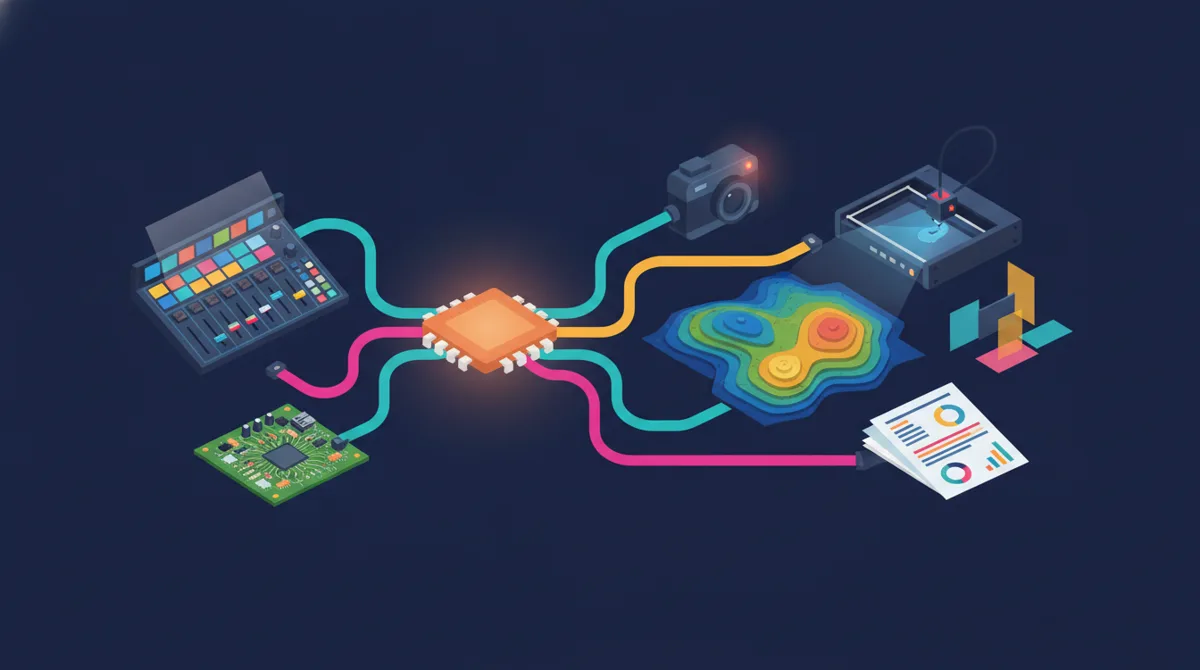
The first wave of MCP servers gave agents things to read: web search, docs, databases. The interesting wave now is servers that let an agent operate a program you already use, the circuit board editor, the GIS package, the music workstation, the streaming app. They are mostly small community projects, they almost all work by opening a local socket into the running app, and they vary enormously in how much you should trust them. We reviewed nine of them, plus one tool for video.
Engineering and making
QGIS MCP (4.0) is the most carefully built of the group. Nicolas Karasiak's server drives a running QGIS Desktop through a plugin, with 125 tools that cover loading layers, editing features, running Processing algorithms and printing atlas layouts. Note which repo you install: the better-known jjsantos01 version has about 1,140 stars but no commit since October 2025, while this one shipped v0.15.2 in October 2026. Its execute_code tool runs arbitrary PyQGIS, and the local socket has no authentication unless you set a token.
KiCAD MCP Server (3.9) is the broadest way into electronics design, at about 250 tools for schematics, placement, routing, design-rule checks, JLCPCB part lookup and Gerber export. Treat it as a quick junior layout assistant. Its own README warns of possible project file corruption, and before v2.8.3 export_gerber could report success without writing any files. Keep every board in git and have an engineer check it.
Nestbolt (3.7) solves a problem anyone with a laser cutter knows: fitting dozens of parts onto a sheet with the least waste. A Rust engine runs locally with no account and no network, checks every layout with an independent validator, and exports one SVG and DXF per sheet. The engineering is serious and the benchmark is published in full, but the project is three weeks old, so trial it on scrap first.
Creative tools
Ableton MCP (3.8) is the most used bridge into Ableton Live, with about 3,280 stars and 37 tools for tracks, MIDI clips, devices and arrangement. It is good at setting up a session and sketching ideas, and much weaker as a composer than the demos suggest. Anonymous telemetry is on by default; set ABLETON_MCP_DISABLE_TELEMETRY=true to switch it off.
No OBS server leads its field. agentic-obs (3.3) is the fullest, with 81 tools over OBS's built-in WebSocket for scenes, sources, audio, recording and streaming. That is a small lead in a thin field: about 39 stars, no releases, and no commit since April.
claude-real-video (4.0) is the one non-server pick here, because its main forms are a skill and a Claude Code plugin; it also ships an MCP server. Claude cannot take a video file, so crv extracts a frame at each scene change, removes near-duplicates and adds a timestamped Whisper transcript, all on your machine. On the author's benchmark a three-minute video came to about 52,000 image tokens, so set a frame cap for long videos.
Your own records
Paperless-NGX MCP (3.8) gives an agent a self-hosted document archive: search, upload, tag, merge and split, through about 31 tools. Install Baruch Rothkoff's maintained fork, not the original, which stopped in November 2025. Whatever your API token can do, the agent can do too, including bulk deletes that have no confirm step. A token with fewer rights is the only real safeguard.
Google Photos MCP (2.8) is a well-built server that Google has mostly closed off. Since 31 March 2025, third-party apps can only search and read the photos they uploaded themselves. Reaching the rest of your library means opening Google's Picker and choosing photos by hand. It can upload and organise, but it cannot find last summer's beach photos for you.
The phone and the trading chart
PlaceCall (3.9) is the strangest capability on the list: a hosted server from Voygr that gives your agent a voice bot. It phones a US business, waits through the menus and the hold queue, and returns the outcome, the transcript and the recording. It charges about ten cents for each call that reaches a conversation. Five states are excluded, recordings are kept for 90 days, and only call numbers you have every right to ring.
TradingView MCP Bridge (3.5) is popular, at about 7,030 stars, and clever: it attaches to your TradingView Desktop app through the Chrome debug port and offers 84 tools to read charts and write Pine Script. It relies on undocumented internals of an app whose terms restrict automation. Any local process can control the signed-in app through port 9222, and nothing has been merged to main since July. Use it for personal research and keep it away from an account you cannot afford to lose.
What they share
Nearly every server here works the same way: a plugin or debug port inside the desktop app opens a socket on localhost, often with no authentication, and the MCP server sends commands to it. That is easy to set up and comes with a security cost you should understand. Any program on your machine can reach that socket, and several of these servers include a tool that runs arbitrary code. They also use a lot of context: 125 tools for QGIS and 250 for KiCad sit in every session unless you turn groups off.
Where to start
If you work in GIS, QGIS MCP is mature enough for real projects today. If you design boards, KiCad's server will save you a lot of routine clicking, provided someone runs the checks before anything goes to the fab. For everything else on this list, treat the agent as a fast assistant inside software you still know how to drive yourself, because you will need to.