
Anthropic IPO 2026: What Claude's Historic Wall Street Debut Means for the Future of AI
By ReviewRamble editors ·
The artificial intelligence industry has spent the past several years promising to transform how the world works. Anthropic's initial public offering represents a major test of how much investors believe that transformation is worth.
On 19 November 2026, Anthropic, the company behind the Claude family of AI models, began trading on the Nasdaq under the ticker symbol ANT. Its shares were priced at $83, with the offering initially placing the company at a valuation of approximately $1.5 trillion on a fully diluted basis.
The offering, which closed on 20 November, ultimately included 1.127 billion shares and generated approximately $93.5 billion in gross proceeds, including the full exercise of the underwriters' additional-share option. Approximately $91.6 billion of those gross proceeds went to Anthropic itself.
For perspective, these are figures more commonly associated with the world's largest technology companies than with an AI laboratory founded in 2021.
But focusing exclusively on the valuation misses the more interesting story.
Anthropic is becoming something much larger than a company that builds chatbots. Claude is increasingly used for software development, enterprise automation, research, document processing, and agentic workflows capable of completing complex tasks.
Its IPO raises a fundamental question: are investors valuing an AI model developer, or are they witnessing the emergence of a new software and computing platform?
The distinction matters enormously for developers, businesses, AI startups, and anyone following the future of artificial intelligence.
Anthropic's IPO: The Numbers Behind the Headlines
Anthropic's IPO arrived at a time when the AI sector was experiencing both extraordinary commercial growth and growing scrutiny over its financial sustainability.
Here are the key figures surrounding the listing:
| Metric | Figure |
|---|---|
| IPO price | $83 per share |
| Nasdaq ticker | ANT |
| First trading day | 19 November 2026 |
| Final IPO shares sold | 1.127 billion |
| Total IPO gross proceeds | Approximately $93.5 billion |
| Gross IPO proceeds to Anthropic | Approximately $91.6 billion |
| Concurrent private placement | Approximately $26 billion |
| October 2026 annualised revenue run rate | Approximately $81 billion |
| First-day closing share price | $97.17 |
The final IPO offering was larger than the initially marketed transaction. Anthropic first marketed 825 million shares, raised that to 980 million when it priced the deal, and the underwriters then exercised their option to buy 147 million more.
Separately, Anthropic completed a $26 billion private placement involving major technology companies, including Nvidia, Microsoft, Google, AMD, Broadcom, Micron, and TSMC Partners.
That investor lineup is significant.
These companies are not simply financial backers. Many are deeply involved in supplying the chips, memory, cloud infrastructure, and computing platforms required to develop and deploy advanced AI.
The result is an increasingly interconnected industry in which infrastructure providers can also be investors, strategic partners, and suppliers.
Anthropic's first two days of trading also highlighted the volatility surrounding AI valuations. The stock opened at $111.50 on 19 November and finished at $97.17. On 20 November, it fell further as the broader technology sector experienced selling pressure.
The early trading swings demonstrate that even strong enthusiasm for AI does not eliminate conventional investment risks.
More importantly, they show that the public markets are now being asked to assign prices to businesses whose technological progress, cost structures, and competitive advantages can change unusually quickly.
From AI Safety Laboratory to Enterprise AI Powerhouse
Anthropic was founded in 2021 by former OpenAI researchers and executives, including siblings Dario and Daniela Amodei.
The company initially differentiated itself through its emphasis on AI safety, interpretability, and responsible model development.
Its research approach, including Constitutional AI, attempted to make advanced language models more helpful and reliable while reducing harmful or undesirable behaviour.
That identity remains important, but Anthropic's commercial evolution has become equally significant.
The company now operates across several interconnected markets:
- Claude, its AI assistant for individuals and teams.
- Claude Code, its AI-powered software engineering environment.
- Claude API, allowing developers to integrate its models into applications.
- Enterprise AI products, supporting organisational knowledge work and automation.
- Agentic AI capabilities, enabling software to execute multi-step workflows using external tools.
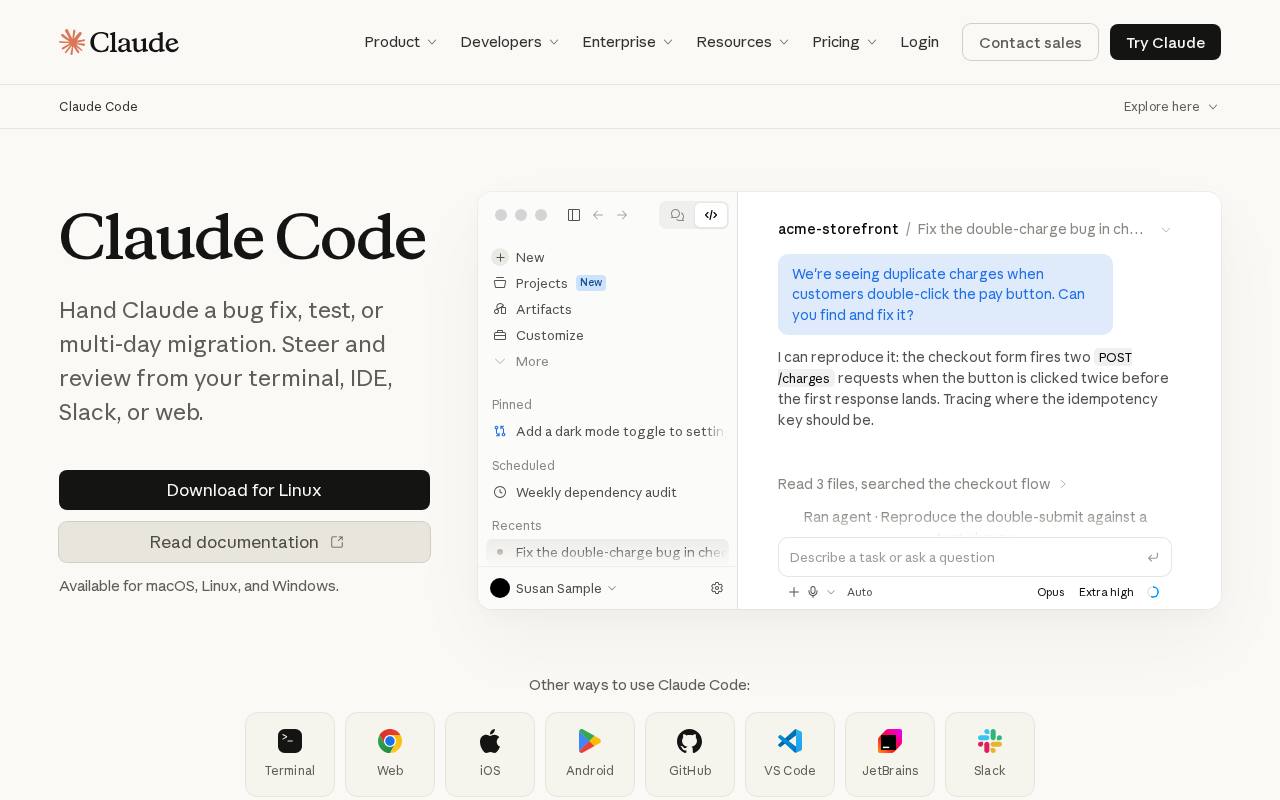
These products serve different customers, but together they form an increasingly integrated ecosystem.
A developer experimenting with Claude can eventually adopt the API for production applications. A company using Claude for internal document analysis might expand into engineering automation, customer support, or financial workflows.
This expansion matters because enterprise software businesses often become more valuable as they move from isolated use cases into recurring, organisation-wide adoption.
Anthropic reported that its annualised revenue run rate reached approximately $81 billion by 31 October 2026, compared with roughly $71 billion a month earlier.
However, an annualised run rate is not the same as recognised annual revenue. It extrapolates recent subscription and usage activity and can fluctuate with customer demand.
Nevertheless, the pace of commercial adoption illustrates how quickly the market for AI services has expanded.
The larger question is whether that growth can translate into sustainable profits once infrastructure spending, model development, and competition are fully accounted for.
Why Claude Code May Be More Important Than the Chatbot
Much of the public conversation around artificial intelligence still revolves around conversational interfaces.
Users ask ChatGPT or Claude a question, receive an answer, and judge the quality of the response.
But one of Anthropic's most strategically important businesses is operating in a different category: AI-assisted software engineering.
Claude Code can work with existing codebases, inspect files, propose changes, execute development workflows, and help troubleshoot complex software problems.
That makes it more than an autocomplete tool.
Traditional coding assistants primarily accelerated individual development activities. Modern AI coding agents are moving toward managing connected tasks across development environments.
For example, an agent may be asked to investigate an application error, locate the relevant source code, implement a fix, execute tests, and prepare changes for review.
This moves AI closer to the actual workflow of software engineering rather than merely helping programmers write individual functions.
The economic opportunity
Software development is an attractive market because businesses already spend substantial amounts on engineering talent, developer infrastructure, testing, security, and maintenance.
If AI tools can reduce the time required for repetitive development tasks, they can create measurable business value.
That does not necessarily mean replacing engineers.
In many organisations, the immediate benefit comes from allowing smaller teams to maintain more software, reducing development backlogs, accelerating prototyping, and automating routine engineering work.
Anthropic's February 2026 funding announcement reported that Claude Code business subscriptions had quadrupled since the beginning of that year, with enterprise usage accounting for more than half of Claude Code revenue.
The expansion of coding agents gives Anthropic a potentially valuable commercial advantage: customers increasingly depend on AI not just for generating content, but for executing work.
That distinction could influence how the market values the company over time.
The Real AI Opportunity Is Moving From Chatbots to Agents
One of the most important implications of Anthropic's IPO concerns the rise of agentic AI.
An AI chatbot generally responds to instructions. An AI agent can use tools, retrieve information, make decisions within defined constraints, and carry out multiple steps toward a goal.
Consider a financial operations workflow.
A conventional AI assistant might summarise an invoice and identify a payment discrepancy.
An AI agent could potentially retrieve the invoice from an accounting system, compare it against a purchase order, check whether the amount falls within an approval threshold, flag inconsistencies, and prepare an entry in an enterprise resource planning system.
The difference is execution.
This creates opportunities across nearly every industry, including banking, healthcare, insurance, retail, software, manufacturing, and professional services.
However, developing dependable AI agents requires more than a capable language model.
Production systems also need:
- Reliable tool execution and error handling.
- Identity, permissions, and authorisation controls.
- Memory and access to relevant business context.
- Monitoring, testing, and evaluation frameworks.
- Human approval for consequential actions.
- Controls against prompt injection and data exposure.
These requirements are becoming a major part of the enterprise AI software market.
Anthropic benefits when developers choose Claude as the reasoning engine behind agentic applications.
But the growth of autonomous AI also creates opportunities for independent software companies specialising in orchestration, observability, security, evaluation, and workflow automation.
The companies building the models may not capture all the economic value created by AI agents.
That could prove to be one of the defining investment and product-development themes of the next decade.
Anthropic vs. OpenAI: The Battle for the AI Platform
Anthropic's public listing also intensifies competition with OpenAI, Google, and other major AI developers.
The competitive landscape is no longer simply a contest over which chatbot produces the best answers.
It is increasingly a battle across multiple layers of the AI technology stack.
| Competitive area | What matters |
|---|---|
| Foundation models | Reasoning, accuracy, speed, and multimodal capabilities |
| Developer tools | Coding agents, APIs, SDKs, and integrations |
| Enterprise adoption | Security, reliability, compliance, and procurement |
| Agent ecosystems | Tool access, orchestration, and workflow execution |
| Infrastructure | Computing capacity and cost efficiency |
| Distribution | Integration into existing products and platforms |
OpenAI has built a broad consumer and developer ecosystem around ChatGPT and its model platforms.
Google benefits from extensive cloud infrastructure, its Gemini model family, and distribution across productivity, search, and mobile products.
Anthropic has developed a strong position in enterprise-focused AI products and software development, while investing heavily in model capabilities and safety research.
Meanwhile, open-weight models create another competitive force.
Organisations can increasingly evaluate whether they need a proprietary frontier model for every workload or whether a smaller, lower-cost model can complete certain tasks adequately.
This creates a difficult long-term pricing challenge.
If multiple providers deliver comparable performance, customers may prioritise cost, latency, reliability, privacy, and ease of integration.
A model developer could produce remarkable technology while still facing pressure on the price customers are willing to pay for access.
For Anthropic, the challenge is therefore not simply to make Claude more intelligent.
It must continually demonstrate that Claude delivers enough differentiated value to justify its economics.
The Hidden Cost of AI: Chips, Data Centres, and Electricity
The largest financial question surrounding Anthropic's IPO may not be how much money Claude can generate.
It may be how much money Anthropic must spend to keep Claude competitive.
Unlike conventional software businesses, frontier AI laboratories require immense amounts of specialised computing infrastructure.
Their expenses include training new models, serving inference requests, running reinforcement learning systems, supporting research, and maintaining globally available services.
Reuters reported that Anthropic spent nearly $9 billion on computing capacity and infrastructure in the first half of 2026, substantially more than during the comparable period a year earlier.
The company's IPO prospectus also describes a broader infrastructure strategy spanning different semiconductor architectures.
These include Nvidia GPUs, AMD accelerators, Google TPUs, and Amazon Trainium chips.
This multi-platform approach serves several purposes.
First, it reduces reliance on a single chip provider.
Second, it allows Anthropic to optimise workloads for different cost and performance characteristics.
Third, it provides additional flexibility when computing demand grows faster than the supply of any particular accelerator.
Anthropic is also expanding beyond purchasing cloud compute into arrangements involving dedicated data centre facilities and specialised hardware.
These investments create major opportunities for the broader technology supply chain.
Semiconductor manufacturers, networking providers, data centre operators, cooling technology suppliers, power infrastructure companies, and energy producers can all benefit from sustained AI demand.
But the infrastructure expansion raises difficult questions.
Will AI revenue grow quickly enough to justify enormous capital commitments? Will more efficient models reduce computing costs, or encourage greater usage? Can electricity grids and data centre construction keep pace with demand?
These are not purely financial concerns.
They affect local communities, environmental policy, water consumption, energy prices, and the physical infrastructure required to support the digital economy.
Anthropic's IPO provides investors with another way to evaluate the relationship between AI revenue growth and the enormous physical resources required to support it.
Why AI Infrastructure Partnerships Deserve Closer Attention
The participation of major semiconductor and cloud companies in Anthropic's concurrent private placement illustrates a distinctive characteristic of the AI economy.
The same companies can occupy several roles simultaneously.
A chipmaker may supply accelerators to an AI laboratory, invest in that laboratory, collaborate on hardware optimisation, and benefit when the laboratory increases its computing expenditures.
A cloud provider may distribute Claude to enterprise customers while also supplying a portion of the underlying infrastructure.
Such arrangements can help finance expansion and improve access to scarce computing resources.
However, they also complicate the financial picture.
Investors need to distinguish between independent end-user demand, strategic financing, infrastructure commitments, and commercial relationships involving the same participants.
This does not mean AI revenue is artificial or that these partnerships lack commercial substance.
It means that understanding the AI industry increasingly requires examining the relationships between its participants rather than analysing each company independently.
Anthropic's prospectus makes these dependencies more visible to the public.
For analysts studying the sector, that transparency may prove nearly as important as the IPO itself.
What Anthropic's IPO Means for AI Startups
For smaller AI companies, Anthropic's public debut is both encouraging and challenging.
It demonstrates that investors are willing to assign substantial value to businesses developing and commercialising advanced artificial intelligence.
But it also reinforces how difficult it may be for smaller companies to compete directly in frontier-model development.
Training leading models can require enormous amounts of capital, specialised talent, large datasets, and access to scarce computing resources.
Most startups cannot realistically match those resources.
Fortunately, competing at the foundation-model layer is not the only way to build a successful AI business.
Opportunities outside foundation models
Some of the most promising areas for startups include industry-specific AI applications, agent security, evaluation systems, enterprise integrations, document intelligence, workflow automation, and cost-management platforms.
For instance, a healthcare AI product may create value through its understanding of clinical workflows, integrations, and regulatory requirements rather than through ownership of a proprietary foundation model.
Similarly, an enterprise agent platform can differentiate itself through access controls, auditing, workflow reliability, and integration with existing business systems.
These are capabilities organisations require regardless of whether the underlying model comes from Anthropic, OpenAI, Google, or an open-weight alternative.
This suggests that AI startups should focus less on creating another generic chatbot and more on solving difficult, measurable business problems.
A product that saves a company significant processing time, improves operational accuracy, or reduces compliance risk may be easier to commercialise than a conversational assistant with limited differentiation.
The growth of Anthropic and its competitors could therefore expand the market for independent AI software rather than eliminate it.
Will Anthropic's IPO Accelerate AI Innovation?
Access to public-market capital can give Anthropic additional resources to expand research, infrastructure, and commercial operations.
That could translate into stronger models, improved developer tools, and more extensive enterprise offerings.
But public ownership also changes the pressures facing a technology company.
Investors will increasingly scrutinise revenue growth, profitability, operating expenses, capital expenditures, and competitive positioning.
This can encourage greater financial discipline.
It can also create tension between ambitious long-term research and the expectations of shareholders seeking predictable financial results.
AI safety presents an additional dimension.
Anthropic has repeatedly emphasised responsible AI development, yet maintaining extensive safety research and evaluation programmes requires resources.
As competition intensifies, the company will need to balance rapid product releases with careful testing and risk management.
Public-market scrutiny could strengthen that discipline by making spending, governance, and risk disclosures more visible.
Alternatively, pressure to demonstrate growth could create incentives to move faster.
The outcome will depend on management decisions, regulatory developments, customer expectations, and the company's ability to preserve trust while scaling.
Five Questions That Will Define Anthropic's Future
Anthropic's IPO is a milestone, but it does not resolve the biggest questions facing the AI industry.
1. Can Anthropic maintain frontier-model leadership?
AI capabilities evolve rapidly. Maintaining a competitive model portfolio requires continued research breakthroughs, strong engineering execution, and substantial computing resources.
2. Can Claude become a durable enterprise platform?
Enterprise customers want more than impressive demonstrations. They need dependable systems that integrate with existing data, meet security requirements, and produce measurable returns.
3. Will AI inference become substantially cheaper?
Improved hardware and model efficiency could reduce the cost of individual AI tasks. That may increase adoption, but could also place downward pressure on model pricing.
4. How much of the AI market will open-weight models capture?
Open-weight alternatives may become increasingly attractive for organisations seeking customisation, deployment flexibility, or greater control over infrastructure costs.
5. Can Anthropic convert extraordinary growth into sustainable profitability?
This is perhaps the most important long-term financial question. Revenue growth alone does not guarantee durable shareholder value when operating and infrastructure costs are exceptionally high.
Each answer will help determine whether Anthropic ultimately resembles a highly profitable software platform, a capital-intensive infrastructure business, or a combination of both.
What Should Businesses and Developers Do Now?
For businesses evaluating AI adoption, Anthropic's IPO should not be interpreted as a reason to commit exclusively to Claude or any other model provider.
Instead, it reinforces the importance of designing AI systems that can adapt as the market changes.
Organisations should evaluate models using their own workloads rather than relying exclusively on public benchmarks.
A model that performs exceptionally well on a general reasoning test may not be the most economical choice for document extraction, customer support, software maintenance, or classification.
Reliability, latency, cost per completed task, security, and integration requirements often matter as much as raw model capability.
Developers should also consider architectures that allow multiple models to be evaluated or substituted when practical.
That does not mean every application needs a complicated multi-model orchestration layer.
It means avoiding unnecessary dependencies that could make future changes expensive.
Agentic applications deserve particular attention.
As AI systems gain access to databases, APIs, production environments, and financial workflows, organisations need to treat identity, permissions, testing, and human oversight as fundamental engineering requirements.
A highly capable AI agent without adequate operational controls can create risks that a conventional chatbot does not.
The most successful enterprise AI implementations are likely to combine capable models with dependable software engineering, strong governance, and clearly defined business outcomes.
The Bigger Picture: AI Is Becoming an Industry, Not Just a Technology Trend
Anthropic's IPO arrives at a pivotal moment in the development of artificial intelligence.
The industry is moving beyond the initial excitement surrounding conversational AI and into a more demanding phase of commercialisation.
Businesses are no longer satisfied with demonstrations showing that a model can draft an email or answer questions.
They want AI systems that can improve productivity, automate processes, accelerate software development, analyse information, and operate reliably within complex organisations.
At the same time, investors are asking whether the extraordinary sums spent on chips, data centres, research, and infrastructure will generate sufficient economic returns.
Anthropic sits at the intersection of these two developments.
Its IPO demonstrates both the magnitude of the opportunity and the extraordinary costs of competing at the frontier.
For developers and AI startups, the most important lesson may be that the AI market is becoming more diverse.
Foundation models are essential, but they are only one part of the ecosystem.
The next generation of valuable AI companies may emerge in agent orchestration, security, evaluation, specialised applications, enterprise integrations, or technologies that make advanced AI more efficient and accessible.
Final Thoughts
Anthropic's public debut is one of the defining technology-market events of 2026.
Yet the size of its IPO should not distract from the questions that will determine its long-term importance.
Can Claude remain competitive? Can autonomous agents become reliable enough for widespread enterprise use? Can infrastructure spending become economically sustainable? And can AI businesses consistently deliver more value than they cost?
These questions extend far beyond Anthropic.
They will shape how organisations purchase AI, how developers build applications, and where entrepreneurs find the next major opportunities.
For ReviewRamble readers exploring the evolving AI landscape, the most important takeaway is straightforward:
Anthropic's IPO is not the culmination of the AI revolution. It is a sign that the industry has entered a new phase in which technical capability must increasingly be matched by economic sustainability, reliability, and real-world value.
And that transition may prove far more consequential than the size of any single public offering.
Frequently Asked Questions
Is Anthropic publicly traded?
Yes. Anthropic began trading on the Nasdaq on 19 November 2026, under the ticker symbol ANT. The IPO closed on 20 November.
What was Anthropic's IPO price?
Anthropic priced its shares at $83 each. The stock closed its first trading session at $97.17, approximately 17% above its IPO price.
How much money did Anthropic raise in its IPO?
The completed offering generated approximately $93.5 billion in gross proceeds, including shares sold by existing stockholders. Anthropic received approximately $91.6 billion before underwriting costs and other offering expenses. A separate $26 billion private placement was also completed.
Is Anthropic the company behind Claude AI?
Yes. Anthropic develops Claude, a family of AI models used for reasoning, coding, analysis, research, and enterprise applications. Its ecosystem also includes Claude Code and developer APIs.
Is Anthropic a competitor to OpenAI?
Yes. Anthropic and OpenAI compete across foundation models, developer tools, enterprise AI products, and agentic applications. Both companies are important participants in the commercial AI market.
Why is Anthropic's IPO important for AI developers?
The IPO highlights the growing commercial market for AI software and infrastructure. It also increases attention on the businesses building applications, developer tools, security systems, evaluation platforms, and specialised services around foundation models.
Does Anthropic's IPO mean AI companies are profitable?
No. A successful IPO demonstrates investor demand for a company's shares, not profitability. Anthropic still faces substantial infrastructure costs, research expenses, competitive pressure, and risks associated with scaling its operations.
Sources and Further Reading
- Anthropic: official IPO closing announcement, 20 November 2026.
- Anthropic: IPO pricing announcement, 18 November 2026.
- Anthropic: Investor Relations.
- Anthropic, PBC: final prospectus (Form 424B4), SEC, 19 November 2026.
- Anthropic, PBC: SEC registration statement (S-1/A), 17 November 2026.
- Anthropic: Series H funding announcement, May 2026.
- Anthropic: Series G funding announcement, February 2026.
- Reuters: Anthropic IPO valuation and infrastructure costs, 18 November 2026.
- Yahoo Finance: Anthropic IPO live: stock closes day at $97, 19 November 2026.
Financial figures are based on publicly available filings and announcements as of 21 November 2026. This article is for informational purposes and does not constitute investment advice.